
I Stopped Publishing Because of WordPress
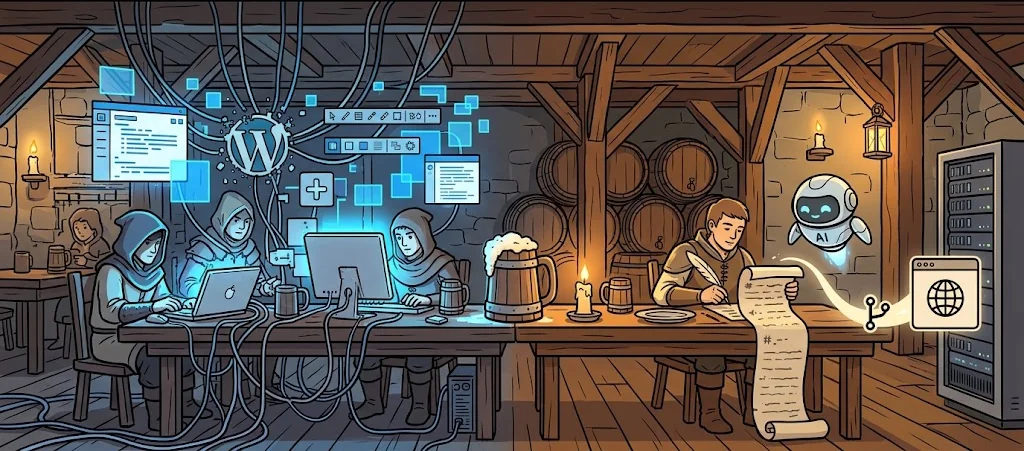
I have kept this blog on WordPress since July 2008, and for a long time that was fine. Over the years, though, it became harder and harder to stay motivated. By 2026 I had a pile of things worth writing about, mostly around AI, and I was spending more time fighting the tool than writing the posts. That is why I’m looking for an alternative. I haven’t left WordPress yet, so this is not a victory lap, just an explanation of how it wore me down.
From a blank page to a control panel
I was on WordPress.com, where the classic editor was a great place to write. One big text field, simple markup, and my hands never left the keyboard. I often wrote in external tools with good spell checkers, and moving text between them and WordPress was as easy as copy and paste.
Then the block editor arrived, and I felt forced into it. I never found a way to keep the classic editor on WordPress.com. Every paragraph became its own container, pressing Enter created a new block, and the interface kept pulling my eyes to floating toolbars and side panels. A blank page had turned into a control panel. I wanted to spend my energy on the next idea, but I spent it working out why a list had split in two and why the structure I typed was not the structure I got.
Today I can’t imagine working on publications without an LLM, and my ideal workflow is simple: write freely in a lightweight markup language, then publish the text as it is. A wiki syntax would do, but Markdown is the predominant one today, so it wins. WordPress broke that workflow. Pasting text generated or polished elsewhere into the block editor always gave a frustrating result that I had to repair by hand. For a technical blog, full of code and lists, that tax was too high. And it doesn’t look like the platform has evolved to fix this, or intends to.
Death by a thousand cuts
The editor was the main reason, but it wasn’t the only one. The statistics were useful at first, then became simpler and less helpful. The panels and dialogs grew more confusing and cluttered, and constant prompts to upgrade to a paid plan kept interrupting the work. Even the conveniences that once justified the platform became half-working. Automatic reposting to social networks got worse and worse: on Facebook, a new post now becomes a bare link, with no image and no introductory text, and on LinkedIn it turns into an unattractive post that nobody would want to click. In the end I was fighting the tool instead of using it.
Why I stayed so long
It wasn’t all bad. New posts were indexed by Google quickly, the statistics were a real plus in the beginning, and the comment system is worth having. WordPress is not a bad product either: if you want a visual site builder, or work with people who don’t write markup, the block editor solves a real problem. Mine is narrower. I write linear technical text, and I want to write it in plain text.
What I’m looking at now
I ruled out self-hosting, including a static site on my own VPS, because I don’t want to maintain servers, updates and security. What I’m evaluating instead is a static site generated from Markdown files kept in Git. The text is mine, in the format I already write in, and it can move to another host whenever I want. This very page is built that way.
I won’t pretend to know yet what I will lose. Indexing speed, statistics, comments and social sharing all need to be checked in practice. If the experiment works, part 2 will be about what I actually lost, and what I didn’t miss at all.